Eight Hours Of The Wrong Sleep - Why the Number Your Wearable Tracks Is The One That Matters Least
He slept eight hours. The wearable confirmed it. The green ring closed. The sleep score read seventy-eight — good, the app said, above average for his age group. He set the phone down and lay there for a moment before getting up. And felt nothing like rested.
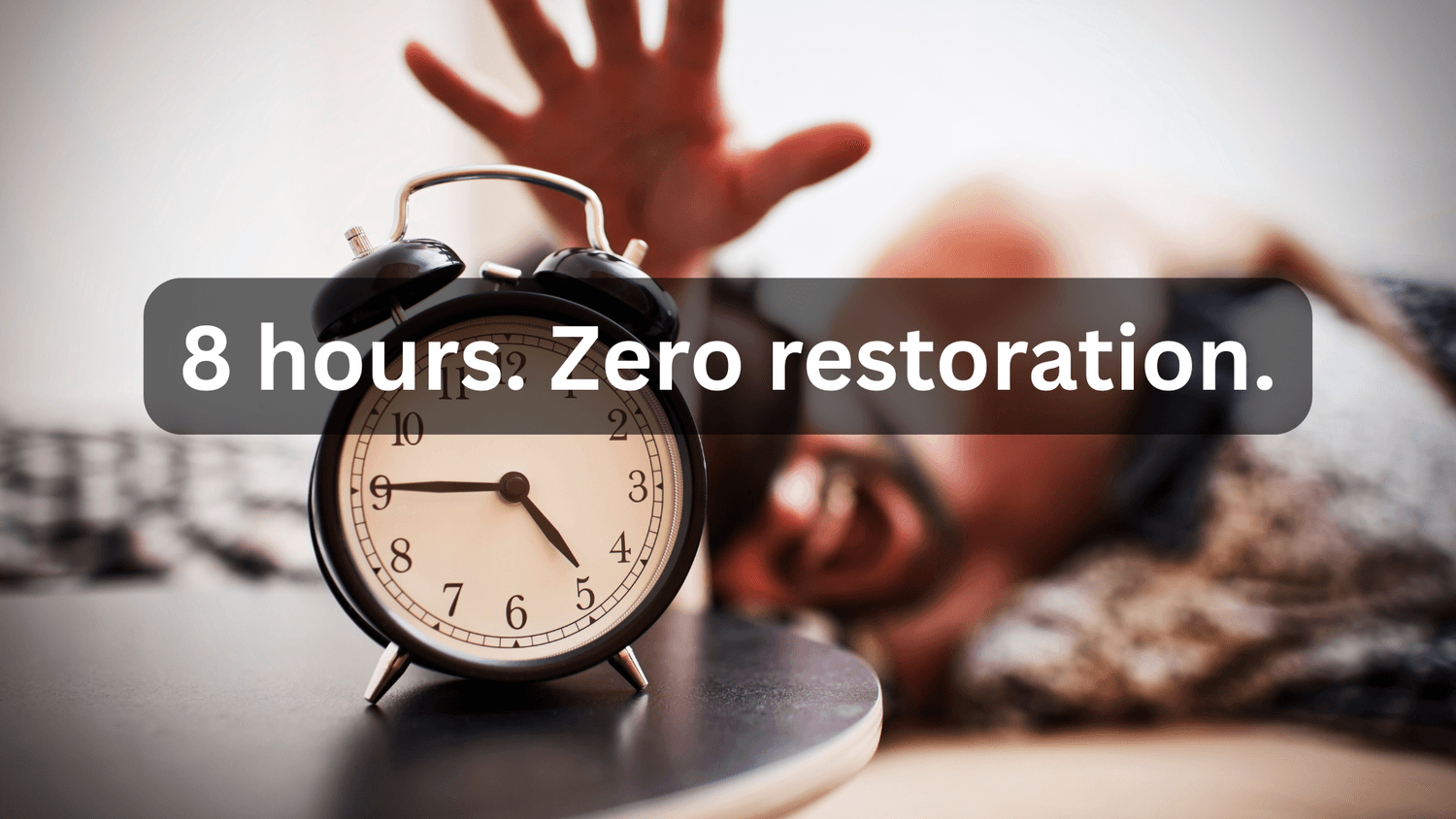
Not the heaviness of a genuinely bad night — the kind that explains itself, that carries its own obvious cause. This was something quieter and more unsettling. A flatness behind the eyes that coffee would partially address but never resolve. A cognitive drag that arrived before the first meeting and stayed through the last. A body that had technically been horizontal for eight hours and had not, by
any meaningful biological measure, recovered.
This is the pattern that arrives in clinical practice with a specific consistency. Not the founder who is obviously not sleeping — the one who knows it, whose circles are visible, whose performance has visibly degraded. That founder is easier to read. The harder case is the man whose numbers look fine. Who went to bed at a reasonable hour. Who did not drink. Who has the expensive mattress and the blackout curtains and the magnesium glycinate on the nightstand. Who did everything the culture told him to do.
And woke up tired anyway.
The instrument told him he slept. The biology disagrees. And the reason this gap exists — between what the wearable measures and what the body actually experienced between midnight and six am — is one of the most important clinical distinctions in longevity medicine that almost nobody in the founder health space has named clearly.
Total sleep time is a quantity metric. It measures duration. It confirms presence. It tells you how long the body was in bed — and almost nothing about what the body was doing while it was there.
What actually restores a founder is not eight hours. It is what happens inside those eight hours — and specifically, whether the biology descended far enough, for long enough, into the stages where restoration actually occurs.
What the Wearable Cannot See
Because total sleep time measures duration rather than depth, the founder who tracks his sleep with a wearable is measuring the wrong variable — and optimising toward a number that has almost no clinical relationship to how restored he actually is.
Sleep is not a single state. It is an architecture — a precise sequence of stages that the brain cycles through four to six times across the night, each serving a distinct biological function that no other stage can substitute for.
Stage N1 and N2 are light sleep. The body is resting. The heart rate has dropped slightly. The founder is technically asleep. But the cellular repair is minimal. The growth hormone has not released. The glymphatic system — the brain's waste clearance network, responsible for flushing the metabolic debris that accumulates during a day of high cognitive load — has not activated. Light sleep is the lobby.
It is not the destination.
Stage N3 is slow-wave deep sleep. This is where restoration actually occurs. Growth hormone releases in its largest nocturnal pulse. Tissue repairs. The immune system consolidates. The glymphatic system opens fully — cerebrospinal fluid flows through the brain, clearing beta-amyloid plaques and metabolic waste that accumulate during waking hours. The autonomic nervous system downregulates completely. The body does in deep sleep what it cannot do at any other time — and what no supplement, no recovery tool, and no amount of additional time in bed can replicate if this stage is not reached.
Optimal deep sleep should comprise thirteen to twenty-three percent of total sleep time. In a founder whose nervous system has been running sympathetic dominance for years, deep sleep frequently collapses to five or six percent — sometimes less. The wearable reports eight hours. The biology delivered forty minutes of actual restoration.
The metric that reveals this is not total sleep time. It is deep sleep percentage — the proportion of the night spent in Stage N3. And alongside it, the overnight HRV recovery curve — which in a regulated nervous system should trace the shape of a hammock, descending in the first half of the night as the parasympathetic system takes over, rising again before waking as the body prepares to re-engage.
A flat overnight HRV curve means the parasympathetic system never fully asserted itself. The body stayed in the lobby all night. The green ring closed. The score read seventy-eight. The founder woke unrestored — and the instrument that was supposed to tell him why had no language for what actually happened.
Why the Descent Fails
Because deep sleep requires the parasympathetic system to assert itself completely, the question becomes precise: what prevents that assertion — and why does a founder who goes to bed at a reasonable hour, in a dark room, without alcohol, still find his nervous system unable to make the descent?
The answer begins earlier in the day than he expects.
The descent into slow-wave deep sleep is not a passive event. It is an active biological transition — a precisely sequenced handoff from sympathetic to parasympathetic dominance that requires specific physiological conditions to be met before it can occur. Core body temperature must drop by approximately one degree Celsius. Heart rate must descend below its daytime baseline and continue falling.
Cortisol — which should reach its lowest point of the twenty-four hour cycle between midnight and two am — must have already tapered significantly before the body will permit the transition into Stage N3.
When the founder's evening cortisol is elevated — not dramatically, not clinically, just persistently higher than the biological rhythm requires — the transition cannot complete. The nervous system reads the cortisol signal as evidence that the environment is still demanding. That it is not yet safe to release the vigilance that sympathetic dominance provides. And so it stays in light sleep.
Technically resting. Biologically unreached.
The cortisol elevation does not arrive at bedtime. It arrives at the 3pm meeting that ran long, at the financial model reopened at seven, at the email answered at nine that reactivated the problem-solving loop the nervous system was beginning to release. Each of these is a small sympathetic reactivation — individually manageable, cumulatively significant. By the time the founder's head reaches the pillow, his cortisol is three hours behind where it needs to be. The descent requires conditions that the evening has systematically prevented from forming.
There is a second mechanism that deepens the problem.
Mouth breathing during sleep — common in founders whose nasal passages are chronically inflamed from poor air quality or stress-related immune suppression — bypasses the nasal turbinates entirely. The nitric oxide produced in the sinuses, which enhances oxygen absorption and activates vagal tone, never reaches the lungs. Instead, shallow chest breathing activates the sympathetic nerve receptors concentrated in the upper lobes — and the brain, reading dry, rapid, lower-oxygen air as a threat signal, maintains a state of fragmented vigilance throughout the night.
The founder did not fail to sleep. His biology failed to descend. And the conditions that prevented the descent were built into the sixteen hours that preceded the moment he closed his eyes.
When Evening Yang Will Not Yield
Because the descent fails when the biological conditions for it are not met, Chinese Medicine arrives at this moment with an observation so precise it reads less like ancient philosophy and more like a clinical description of the HRV curve the founder's wearable produced last night.
Yang is the active, warming, expanding force. It rises with the sun — peaking at noon, driving the cognitive output, the decision-making, the metabolic heat of a full day of high-stakes work. Yin is the receptive, cooling, contracting force. It deepens with the dark — drawing the system inward, lowering temperature, quieting the mind, preparing the body for the descent that restoration requires.
The exchange between them is not passive. It is an active handoff — Yang yielding to Yin at dusk, creating the conditions in which the body can descend. This exchange has a biological signature that Western medicine now measures precisely: the evening cortisol taper, the drop in core body temperature, the rising vagal tone that traces the beginning of the HRV hammock curve.
When the evening Yang will not yield — when cortisol stays elevated, when the screen keeps firing the sympathetic system, when the last email reactivates the problem-solving loop that the nervous system was beginning to release — the Yin cannot descend. The body stays in a state of low-grade Yang activation. Technically resting. Biologically unreached.
Chinese Medicine has a precise name for what happens when Yang fails to yield at the correct time: Floating Yang. The same mechanism that produces the racing mind at eleven pm, the inability to fully release into sleep, the 3am waking that feels less like waking and more like being switched on — is the Yang that was never properly anchored by the Yin below it. The fire rose. Nothing below was cool enough to hold it down.
The Western biomarker picture confirms this with exactitude. Elevated evening cortisol — Yang that has not tapered. Suppressed nocturnal vagal activity — Yin that could not assert itself. Collapsed deep sleep percentage — the descent that never completed. Low overnight HRV — a nervous system that never released the vigilance the day demanded of it.
Two systems. Two languages. The same exhausted founder lying in the dark, technically asleep, biologically unrestored — because the evening Yang refused to yield and the Yin had no conditions in which to deepen.
The ancient observation and the modern HRV curve are describing the same physiological event. Chinese Medicine simply named it two thousand years before the wearable arrived to measure it.
What Actually Restores the Descent
Because the descent fails when evening Yang will not yield and the biological conditions for parasympathetic assertion are absent, the question becomes precise: what actually creates those conditions — and what is the difference between the sleep hygiene advice the founder has already tried and the specific biological engineering that the nervous system actually requires?
The difference is mechanism. Not intention. Not discipline. Mechanism.
The first condition is thermal. To enter Stage N3, core body temperature must drop by approximately one degree Celsius. This is not a comfort preference — it is a biological gate. The body cannot descend into slow-wave sleep while core temperature remains elevated. An ambient room temperature of fifteen to nineteen degrees Celsius actively draws heat away from the body, accelerating the thermal drop the parasympathetic transition requires. A heavy meal within four hours of sleep prevents it — the thermic effect of digestion keeps core temperature elevated for three to five hours after eating, holding the body in light sleep regardless of how dark or quiet the room is. The four-hour digestive buffer is not a wellness recommendation. It is a thermal engineering requirement.
The second condition is respiratory. Nasal breathing during sleep is not optional for a nervous system attempting to descend. The nasal turbinates produce nitric oxide — a vasodilator that enhances oxygen absorption in the lungs and directly stimulates vagal tone. Mouth breathing bypasses this entirely. The brain reads the dry, rapid, lower-oxygen air as a low-grade threat signal and maintains sympathetic vigilance throughout the night. The founder who tapes his mouth — not as a biohacking experiment but as a precise mechanical intervention — forces nasal breathing, increases intrathoracic pressure, activates the diaphragm fully, and delivers nitric oxide to the lungs with every breath. The vagal tone rises. The descent becomes available.
The third condition is acoustic. Sudden ambient sound — even sounds that do not fully wake the founder — triggers immediate sympathetic spikes that interrupt the architecture of the night. Not the average volume but the variance. A consistent pink noise background eliminates variance, masking the sudden sounds that would otherwise pull the nervous system back toward the surface before the descent has completed.
The fourth condition is glycaemic. A blood sugar crash three to four hours into sleep — triggered by a high-glycaemic meal too close to bedtime — produces a cortisol and glucagon surge as the brain responds to what it reads as a starvation signal. The founder wakes at 3am. Or does not fully wake but shifts from Stage N3 into light sleep. The deep sleep window closes. The glymphatic system pauses mid-cycle. The restoration that was beginning does not complete.
None of these are tips. They are the specific biological conditions the nervous system requires to make the transition from sympathetic to parasympathetic deeply enough to reach the stage where restoration actually occurs. The founder who addresses all four — not as a protocol to be optimised but as a nightly engineering of the correct environment — creates the conditions in which the body can finally do what it has been trying to do every night for years.
The descent was never the problem. The conditions for it were.
The Measure That Matters
Because the descent requires specific biological conditions rather than additional hours in bed, the founder who has spent years optimising his sleep around the wrong metric arrives at a precise reorientation.
Stop tracking total sleep time. Start tracking deep sleep percentage and the overnight HRV recovery curve.
These two numbers tell the clinical story that total sleep time cannot. Deep sleep percentage reveals whether the body actually descended — whether Stage N3 was reached in sufficient proportion for growth hormone to release, for the glymphatic system to open, for the cellular repair that no other stage can substitute to have actually occurred.
The target is thirteen to twenty-three percent of total sleep time. A founder consistently below ten percent is not sleeping poorly. He is not sleeping restoratively at all — regardless of what the total hours say.
The overnight HRV curve reveals whether the nervous system made the transition. The hammock shape — descending in the first half of the night as parasympathetic dominance deepens, rising again in the second half as the body prepares to re-engage — is the biological signature of a nervous system that successfully yielded. A flat curve means the yield never happened. The body stayed in the lobby. Eight hours in the lobby is not rest. It is extended waiting.
These numbers move slowly. The founder whose deep sleep percentage has been at six percent for three years will not see it reach eighteen in a week of correct evening engineering. The nervous system that has been running sympathetic dominance long enough to recalibrate its baseline does not update its model on a single night of good conditions. It updates on accumulated evidence — the consistent, nightly proof that the environment has changed and that the descent is safe.
But when the numbers begin to move — when the deep sleep percentage climbs from six to nine to twelve, when the overnight HRV curve begins to show the first signs of the hammock shape, when the founder wakes one morning and notices that the flatness behind the eyes is not there before he has consciously registered anything about the night — something becomes available that no sleep score, no green ring, and no productivity framework has ever produced.
The experience of having actually rested.
Not the absence of obvious exhaustion. Not the functional adequacy of a man running on borrowed biology. The genuine, cellular, biologically complete restoration of a system that descended far enough, for long enough, into the stage where the body repairs what the day spent and the brain clears what the hours of high-stakes thinking accumulated.
Deep sleep is not a wellness metric. It is the biological condition in which the founder who has been running at the edge of his capacity discovers that his actual capacity — uncompromised, unrestored, unreached for years — was considerably larger than anything he accessed while the descent was failing.
The wearable has been measuring the wrong number.
Now he knows which one to watch.
P.S.
If your sleep score looks fine but you wake up tired, there is a good chance other markers in your biology are telling the same story — numbers sitting just inside the reference range that your doctor called normal and your body knows differently.
I put together a short guide on the seven biological signals most commonly misread in high-performing founders — the readings that look acceptable on a standard panel and are quietly costing capacity, recovery, and longevity.
The 8 Hidden Biological Redlines — available at vitalease.co/redlines