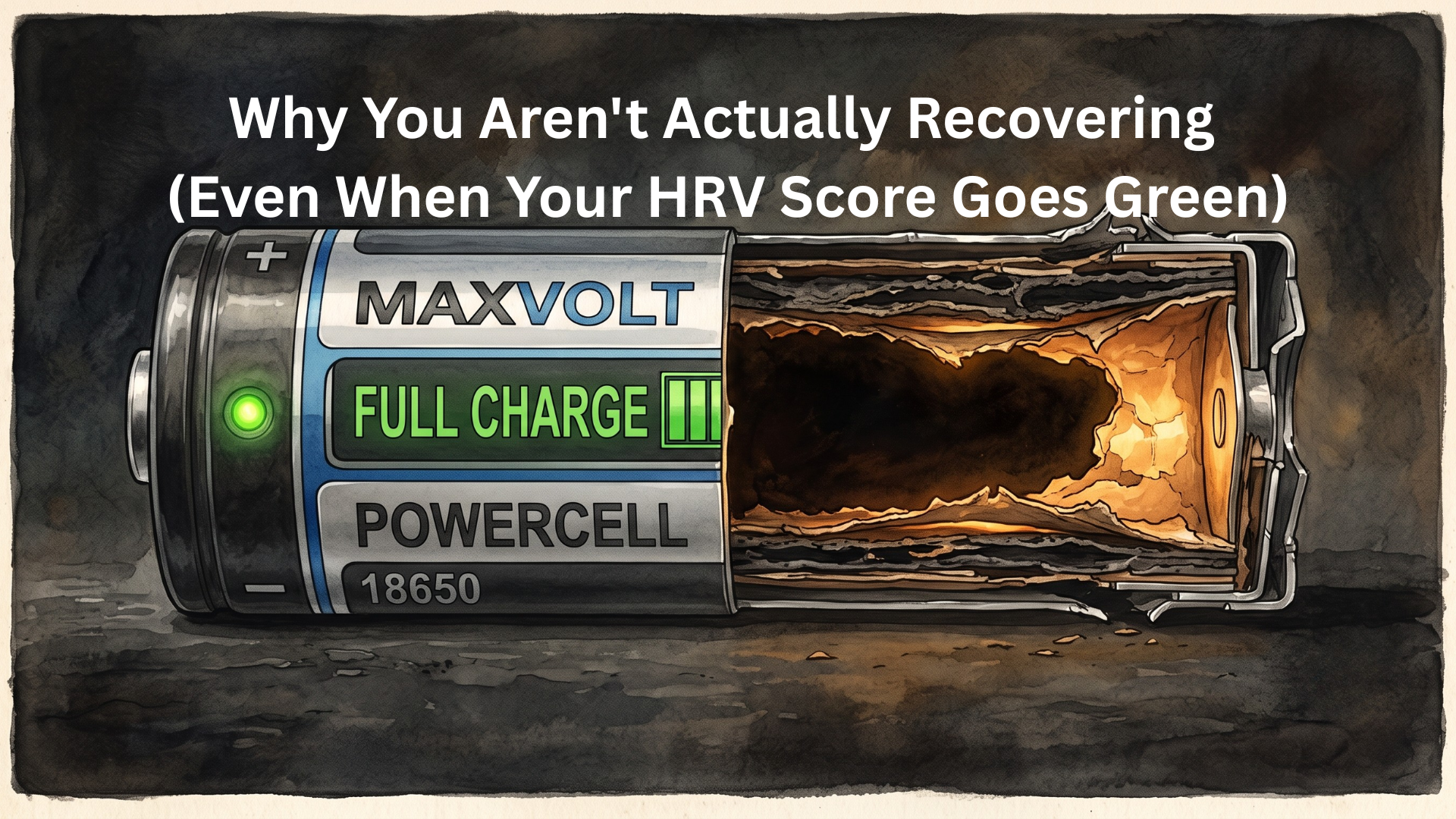
The Nervous System runs on a battery you can´t see charging
Why Your HRV Score Can Improve While Your Recovery Capacity Drains The Score That Lies His HRV went up.
Why Your HRV Score Can Improve While Your Recovery Capacity Drains
The Score That Lies
His HRV went up.
The wearable confirmed it — green ring, readiness score of eighty-three, the app telling him his body was primed and recovered. He had been tracking for fourteen months. He knew what the colours meant. He trusted the number the way a pilot trusts an instrument panel — not blindly, but with the earned confidence of someone who had watched the correlation hold across enough mornings to believe it.
He felt ready. The score said ready. He performed at a level that confirmed ready.
And underneath all of it, something was draining.
Not dramatically. Not in a way that showed up in the number — because the number was rising. Not in a way that showed up in his output — because his output was holding. It showed up in the recovery that was taking fractionally longer each month. In the mornings that required slightly more effort to reach the same baseline. In the sleep that was technically adequate and felt, with growing consistency, like it had not quite finished something it started.
This is the failure mode that no recovery app has been designed to name — because it does not produce a bad score. It produces a good score built on the wrong foundation.
HRV is a composite. It blends both branches of the autonomic nervous system into a single daily number — the sympathetic and the parasympathetic, the accelerator and the brake, the fire and the water, added together and reported as one. When the parasympathetic branch is strong and the sympathetic branch is regulated, the composite rises and the founder is genuinely recovered.
When the parasympathetic branch is quietly weakening and the sympathetic branch is compensating — holding the composite up through its own elevated baseline activity — the number still rises. The colour still goes green.
The score improves. The battery drains.
The instrument is not broken. It is simply reporting the sum — and the sum can look healthy while one of its components collapses. The founder who trusts the composite without reading the branches is navigating with a map that shows the destination but not the road.
What HRV Actually Measures
Because the composite score can rise while one of its components collapses, understanding what HRV actually measures — and what it structurally cannot see — is the clinical foundation the rest of this essay builds on.
HRV is not heart rate. It does not measure how fast the heart beats. It measures the variation in time between consecutive heartbeats — the millisecond-level fluctuation that reflects how dynamically the autonomic nervous system is adapting to the body's changing physiological demands in real time.
A healthy nervous system does not keep the heart beating like a metronome. It allows the heart to accelerate and decelerate continuously — responding to breath, to posture, to metabolic demand, to the subtle shifts in internal environment that occur thousands of times per day without conscious awareness.
The autonomic nervous system governs this variation through two branches. The sympathetic branch — the accelerator — tends to reduce beat-to-beat variation. It narrows the heart's response pattern, optimising for output and vigilance. The parasympathetic branch — the brake — tends to increase beat-to-beat variation. It widens the heart's adaptive range, creating the flexibility that recovery depends on.
A founder whose sympathetic nervous system has been running at elevated baseline for years can produce a rising composite HRV score not because his parasympathetic reserve is rebuilding, but because his sympathetic system is contributing its own form of elevated variability to the composite. The number rises. The recovery branch is not the reason. The composite cannot separate the two contributions. It reports their sum. And the sum looks like recovery.
The Branch That Matters
RMSSD — the root mean square of successive differences between heartbeats — is the metric that reflects parasympathetic activity most directly. While overall HRV captures the full autonomic picture, RMSSD narrows its focus to the short-interval, beat-to-beat variation that the vagus nerve — the primary parasympathetic pathway — produces. When the vagus nerve is active and parasympathetic tone is strong, RMSSD rises. When parasympathetic reserve is depleting — even while the composite score holds or rises through sympathetic compensation — RMSSD begins to trend downward.
This divergence is the clinical signal the composite score hides.
A founder whose overall HRV is stable or rising while his RMSSD is quietly trending downward over weeks is not recovering. He is compensating. The sympathetic branch is holding the composite number up. The parasympathetic branch — the one that actually rebuilds the tissue, consolidates the adaptation, drops the cortisol curve, and produces the deep sleep architecture that restoration requires — is losing ground.
The second signal is resting respiratory rate. Parasympathetic dominance slows the breath. When vagal tone is strong, resting respiratory rate drops — typically into the range of twelve to fourteen breaths per minute.
When the sympathetic system is compensating, resting respiratory rate remains elevated — fifteen, sixteen, seventeen breaths per minute across the night — even when the composite HRV score looks green.
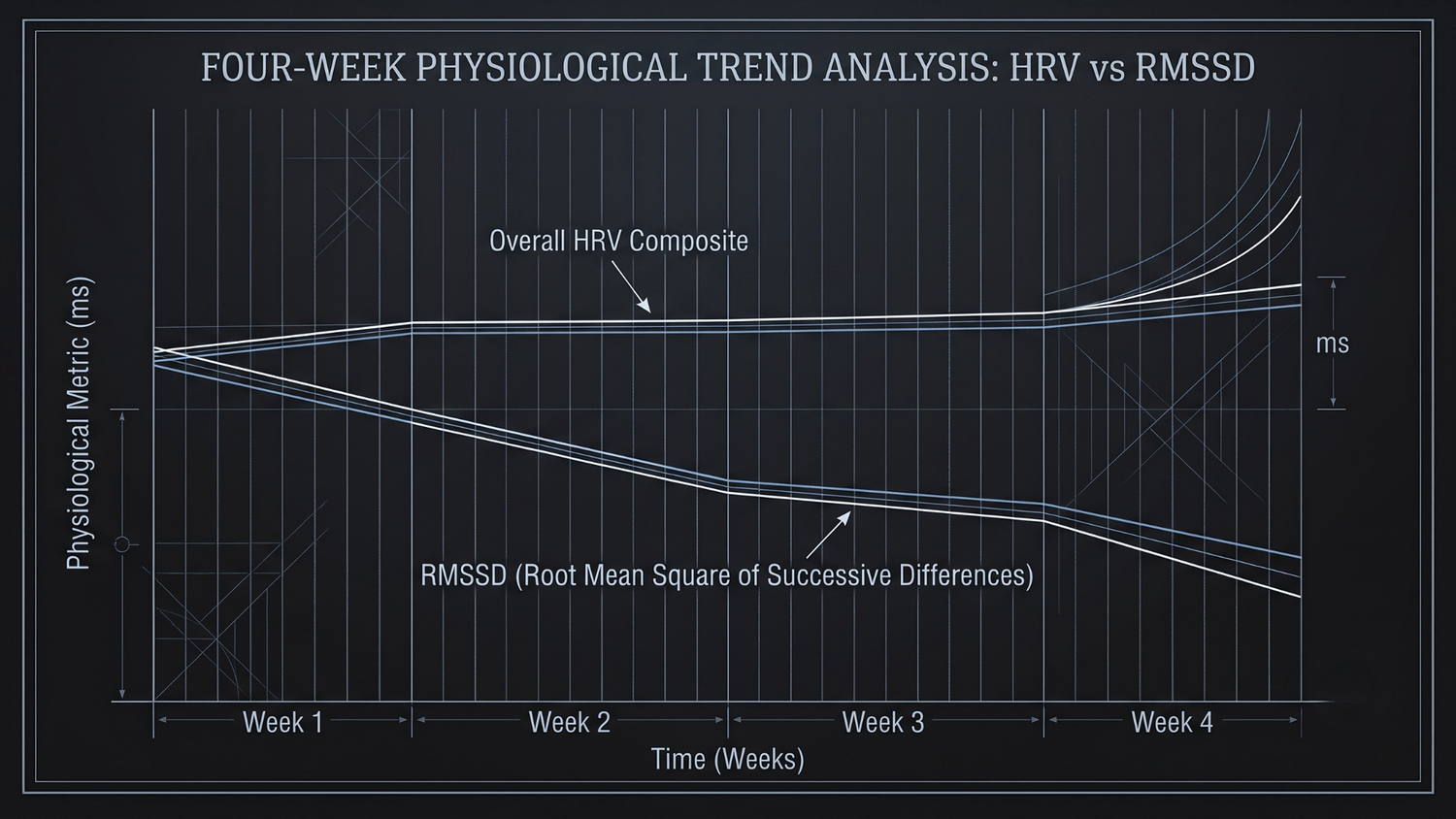
Not: what is my HRV score today? But: is my RMSSD trending upward or downward across the last three weeks — and what is my resting respiratory rate doing while I sleep? Those two questions tell a different story than the composite. And for the founder whose score is green and whose battery is draining, they are the questions that finally name what is actually happening.
The Kan and Li Problem
Kan is water. Li is fire.
In the autonomic nervous system, the parasympathetic branch is Kan — the cooling, descending, restorative force that brings the heart rate down, deepens the breath, opens the recovery window, and rebuilds the biological reserve that the day's demands spent. The sympathetic branch is Li — the warming, ascending, activating force that mobilises output, sharpens focus, and produces the cortisol and adrenaline that high performance requires.
In a regulated nervous system, these two forces exist in dynamic balance. Li rises during the day and yields at dusk. Kan deepens through the night, restoring what Li spent, so that the next day's fire has a full reservoir of water beneath it.
When the sympathetic fire has been burning without adequate parasympathetic restoration for long enough, the water level drops. Not visibly. The fire continues to burn — more intensely, if anything — because without the cooling influence of an adequate water reserve, the heat concentrates rather than disperses. The composite HRV rises. The green ring closes. But the water is receding.
The composite HRV score reports the fire. It does not report the water level. RMSSD reports the water. And when RMSSD trends downward while the composite holds — when the resting respiratory rate stays elevated through the night while the readiness score goes green — the ancient pattern and the modern data are telling the same story in two different languages. The battery is not charging. The fire is simply burning more of what remains.
What Genuine Rebuilding Looks Like
Parasympathetic reserve is rebuilt through the nervous system receiving consistent, repeated signals of safety — not through effort, not through optimisation, and not through adding more inputs to a system that is already processing too many. The vagus nerve is not stimulated into recovery by intensity. It is coaxed back by rhythm.
The most direct signal is breath. Slow nasal breathing — the exhale longer than the inhale, the diaphragm completing its full range of motion, the breath rate dropping below ten cycles per minute — directly activates vagal tone. Each slow exhale produces a measurable increase in RMSSD. Not as a one-session intervention but as a cumulative, daily signal that begins to shift the autonomic baseline over weeks of consistent practice.
The second signal is structural stillness. Zhan Zhuang (Standing Like a Tree) — the specific postural alignment that allows the body to release muscular bracing into the earth — sends the vagus nerve a signal that no supplement and no wearable intervention can replicate. When the structure is correct and the release is genuine, the parasympathetic system begins to assert itself not through instruction but through the removal of the chronic bracing that has been suppressing it.
The RMSSD trend tells the honest story — and when it begins to move upward while the resting respiratory rate begins to drop, the founder is no longer compensating. He is genuinely recovering. For the first time, the score and the biology are saying the same thing.
The Battery You Cannot See Charging
The nervous system runs on a battery the composite score does not directly measure.
It measures the output the battery is producing. It reports the sum of both branches — the fire and the water, the sympathetic and the parasympathetic, blended into a single daily number that looks like readiness when both branches are in balance and still looks like readiness when the fire is compensating for water that is no longer there in sufficient depth to do its restorative work.
The battery is parasympathetic reserve. And it charges slowly, quietly, and only under conditions that the achieving mind finds structurally difficult to create — because the achieving mind runs on the fire, not the water.
This is the final override — the most sophisticated one the achieving mind executes. It learns to track recovery. It acquires the wearable. It monitors the composite score with the same rigorous attention it brings to everything else. And in doing so, it converts the act of recovery into another performance metric. The score goes up. The founder feels he has mastered recovery the way he has mastered everything else. But the battery is draining.
When RMSSD trends upward and resting respiratory rate drops, the battery is charging. When RMSSD trends downward while the composite score holds or rises, the battery is draining — and the fire is borrowing from a reserve that has not been told it is being spent.
Vital Ease is not about helping founders become more productive. It is about restoring the biological and emotional conditions in which health, clarity, meaningful work, and a good life naturally emerge.
The battery cannot be seen charging. But it can be measured. And it can be rebuilt.
Not through a better score. Through the conditions that make the score honest again.
If your HRV score looks good but something in your recovery feels like it has been quietly getting harder to reach, the next clinical question is precise: which branch is actually driving your number — and what is your parasympathetic reserve actually doing while you sleep?
The Sovereign Biological Audit reads both layers simultaneously — the biomarker data that measures your autonomic trajectory and the CM pattern that names what the numbers are pointing toward. Not two separate consultations. One forensic picture of the same biology, read from both sides.