Never Right Since That Winter
Never right since that winter — Why "No Diagnosis" is not the same as no disease. My patient sat down. Let's call her Sonja. It's not her real name. But her story is precise.

Never right since that winter — Why "No Diagnosis" is not the same as no disease. My Patient Sat Down
Let's call her Sonja. It's not her real name. But her story is precise.
She was in her mid-forties when she first came to the clinic. Pale complexion. Visibly tired in the way that sleep no longer fixes — a tiredness that had settled into the tissue rather than sitting on the surface. She moved carefully, as if the body required management rather than trust. Pain throughout — not localised, not sharp, but a diffuse ache that had become so constant she had stopped mentioning it to people because there was nothing new to report.
Sonja's story predates COVID by several years. But since 2020 I have heard versions of it from hundreds of people — and so, I suspect, have you. The illness that arrived, seemed to resolve, and left something behind that the panels could not find and the doctors could not name. The fatigue that did not lift. The brain fog that settled in and stayed. The body that technically recovered and functionally did not.
COVID gave this pattern a name — long-COVID — and brought it into public awareness at a scale that made it impossible to dismiss. Millions of people who can tell you precisely when it changed. Who returned to work, to life, to the appearance of normality, and found themselves running on reduced capacity from a point they could identify exactly. Whose subsequent panels came back unremarkable. Who were told it was probably stress, anxiety, deconditioning — the words medicine reaches for when the instrument has nothing more precise to offer.
Sonja had caught three successive colds across a single winter, three years before she arrived at the clinic. Not unusual. But she had never fully recovered between them. The first left her slightly below her previous baseline. Before she had returned to that baseline the second arrived. The third came before the second had cleared. By spring she was functioning — going to work, managing the household — but something had shifted. She felt like a slightly degraded version of herself, running on reduced capacity, unable to identify exactly what had changed or why.
Over the following years the symptoms accumulated. Body pain that her doctor eventually labelled fibromyalgia. Digestion that was soft and unreliable. A back and feet that were perpetually cold regardless of the season. Night sweats. Temperature that fluctuated without external cause — sometimes warm, sometimes cold, sometimes both within the same hour.
Every panel came back unremarkable.
She was told it was probably stress. Possibly her age. Possibly both.
She had been told this for three years when she arrived at the clinic. And the thing she said at the end of the first consultation — quietly, almost as an aside — was the thing that most post-viral patients eventually say:
I just never felt right after that winter.
Why the Body Sometimes Cannot Complete the Clearance
Because Sonja never fully recovered between the three successive colds, something needs to be understood about what the body was attempting to do — and why it could not finish.
When a pathogen arrives at the exterior, the body's first response is straightforward. It generates heat. It mobilises its defense. And if conditions are right, it produces a resolving sweat — the mechanism that carries the pathogen out and closes the episode cleanly. Fever breaks. Energy returns. The baseline is restored. Most people have experienced this: a few difficult days, then a clear morning where the system feels genuinely recovered.
That clean resolution requires something most people do not think about until it is insufficient.
It requires fluid reserves.
The sweat that drives a pathogen out is not a passive byproduct of fever. It is an active biological operation — the body converting its fluid resources into the mechanism of clearance. When fluid reserves are adequate, the operation completes. When they are not, the fever breaks halfway. The acute phase resolves. Sonja returns to normal life. But the pathogen has not been fully expelled. It has simply moved inward, away from the exterior where the body was trying to clear it, settling at a deeper level where the defense cannot easily reach it.
This is not a failure of the immune system in the conventional sense. The immune system did what it could with what it had. The problem was the terrain — the biological conditions available to the defense at the moment the pathogen arrived.
Sonja had been running on reduced reserves for years before that winter. Chronically fatigued, chronically managing, the kind of low-grade depletion that functions well enough in ordinary conditions but leaves almost no margin when something genuinely demanding arrives. When the first cold came, the clearance was incomplete. When the second arrived before the first had resolved, the reserves were even lower. By the third, the body had almost nothing left to work with.
Each pathogen translocated a little deeper. And at some point something stopped moving altogether — and stayed.
What Stayed and What It Did
Because something stopped moving and stayed at a deeper level, Sonja's body began to organise itself around the presence of something that should not have been there — and the symptom picture that accumulated over three years was not random. It was a map.
The cold back and feet were not a circulation problem in the conventional sense. They were the body's deep warmth failing to reach the extremities — the Yang that should have been distributing heat outward no longer had the reserve to do so. The engine at the root was running below the threshold required to keep the whole system warm.
The alternating heat and cold — sometimes warm, sometimes cold, sometimes both within the same hour — was something different. Not a temperature regulation failure. Something more specific: the body in a state of perpetual low-grade contention, one part of the system trying to push something out, another part unable to complete the push. The result was a fluctuation that felt like instability but was actually the body still attempting, years later, to resolve what had never been resolved.
The night sweats carried the same signal. Not a hormonal story — not primarily. The body generating heat at night, attempting to move something through the exterior while the conscious mind was out of the way. The attempt was real. The completion was not happening.
The body pain — the diffuse, non-localised ache that had settled into the tissue — was the pathogen distributed. Not attacking one structure. Sitting across multiple pathways, generating friction wherever it had lodged, producing the kind of pain that has no clear origin and therefore no clear target for treatment.
The digestion was soft and weak because the system that was supposed to be transforming food into usable energy was running in a compromised environment. Not diseased. Just operating below its natural capacity, like an engine asked to perform at normal output with a fraction of its fuel supply.
And the pulse — weak and deep overall, but with one position carrying a tightness that did not belong alongside the general weakness — told the most precise story. Something was still there. Still active. Still producing a signal, even three years later, even when every panel had returned unremarkable.
The picture was readable. It had been readable the whole time. It simply required an instrument designed to read it.
What the Panel Cannot See
Because the symptom picture was precise and readable, the question that follows is uncomfortable: why had three years of medical consultations produced nothing actionable?
The answer is not that Sonja's doctors were incompetent. They were not. The answer is that the instruments they used were designed to find something specific — and what Sonja had did not fit that something.
Western diagnostic medicine is built around a precise and powerful question: is there overt tissue destruction, gross structural abnormality, or measurable inflammatory markers above the clinical threshold? When the answer is yes, the system is extraordinarily effective. It names the disease, assigns a mechanism, and identifies a target for treatment.
But when the answer is no — when the bloods are unremarkable, the imaging is clean, the antibody panels show nothing flagged — the instrument has reached its ceiling. It has confirmed the absence of the diseases it was designed to detect. It has not confirmed the absence of disease. Those are two different statements. The medical consultation rarely makes the distinction explicit.
COVID demonstrated this at civilisational scale.
Millions of people who had recovered from the acute infection returned to their doctors with fatigue, brain fog, breathlessness, autonomic dysregulation, and a body that did not run the way it used to. The panels came back unremarkable. The imaging was clean. The acute infection had resolved. By every instrument available, these people should have been well.
The Frame That Read the Picture
Because the standard diagnostic sequence had reached its ceiling without naming what was present, what Sonja needed was not a better version of the same instrument.
She needed a different one entirely.
Chinese Medicine does not begin where the standard diagnostic sequence begins. It does not ask: is there measurable tissue destruction? It asks something structurally different: what is the pattern, where is it located, and in which direction is it moving?
This is not a philosophical difference. It is an architectural one. The diagnostic frame was built to read exactly the kind of clinical picture Sonja presented — the picture of a system running differently than it used to, at a compromised baseline, from a point in time that the patient can identify precisely. Most post-viral patients can tell you when it changed. They remember the illness, the incomplete recovery, the moment they returned to life feeling like a slightly degraded version of themselves. That specificity is clinically meaningful. It points to something that arrived, was incompletely cleared, and remained.
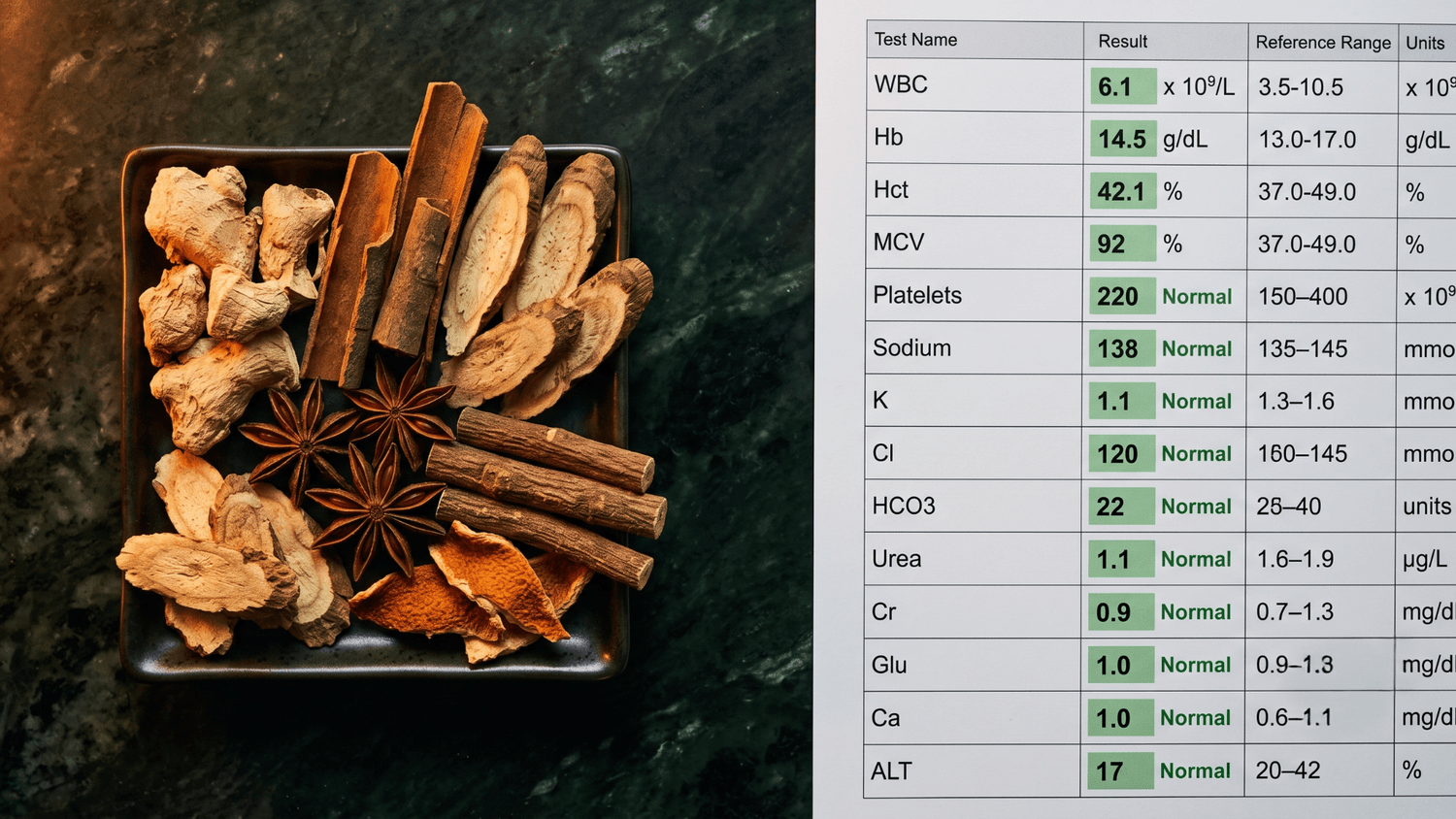
They were not well.
Long-COVID research has been running for five years and is still assembling the mechanistic picture — microclots, mitochondrial suppression, persistent immune activation, autonomic dysfunction. Western science is catching up. But the founders, the patients, the Sonjas of the world have been living without a satisfying account of what happened to them in the meantime. Because the instrument was not designed to read the picture they were presenting.
Sonja received a fibromyalgia diagnosis. Fibromyalgia is not a mechanism. It is a description — a clinical label applied to a specific pattern of widespread pain and fatigue when no other cause has been identified. It tells the patient what the symptom cluster is called. It does not tell her why the symptom cluster exists, what produced it, where in the body the originating problem is located, or what addressing that problem would require.
She was also told it was probably stress. Stress is the name given to unexplained fatigue and systemic dysregulation when the instrument has nothing more precise to offer. It describes the surface without reaching the root. And it offers nothing actionable.
Three years. Multiple consultations. Unremarkable panels. A label that described her suffering without explaining it.
No diagnosis is not the same as no disease. Sonja had a disease. It simply required a different instrument to see it.

Sonja's pulse told part of the story. The cold extremities told another part. The alternating heat and cold, the night sweats, the diffuse pain, the weak digestion — each symptom was a signal from a specific layer of the system, pointing toward the location and nature of what had stayed.
The treatment addressed all layers simultaneously — but the strategic anchor was the deepest level first. Not because the surface was unimportant, but because venting the pathogen from its deepest point of lodging is what creates the conditions for the upper layers to release. Open the root first, and the whole system finds its direction outward. The body had been trying to complete this movement for three years. The treatment gave it the conditions to finally do so.
Not multiple separate strategies applied in sequence. One coherent reading of the whole picture — and a precise intervention that addressed the depth where the problem had its anchor, allowing everything above it to begin moving again.
The frame did not produce a dramatic insight. It simply asked the question the other instrument was not designed to ask. And the answer had been there in the pulse, the tongue, the symptom pattern, and Sonja's own precise recollection of when everything changed.
Sonja, Six Months Later
Because the frame could read what the panel could not, something became possible that three years of unremarkable results had made feel structurally unavailable.
A direction.
Not a cure announced at the end of the first consultation. Not a dramatic reversal. A direction — the specific work of opening the root first, giving the body the conditions it needed to vent what had lodged at its deepest level, and allowing the layers above to follow. The body had been attempting this movement for three years. It had the intelligence. What it had lacked were the conditions to complete it.
The body pain began to reduce within the first few weeks. Not dramatically. But consistently — the diffuse ache becoming slightly less constant, slightly less present, in the way that a sound you have stopped noticing becomes audible again only when it finally quiets. The digestion began to stabilise. The cold back and feet, which had been her permanent baseline for three years, began to warm — slowly, unevenly at first, then with more consistency as the treatment continued.
The alternating heat and cold settled. The night sweats reduced. The energy began to return — not as a spike, not as the artificial lift of stimulation, but as something quieter and more reliable. The kind of energy that is there when you wake rather than something you have to manufacture across the first hour of the day.
Six months after the first consultation, Sonja described herself as eighty percent recovered. Not one hundred. The depletion that had preceded three winters of incomplete clearance was not fully restored in six months — and it would not be. That kind of restoration takes the time it takes. But eighty percent was not a number she had been able to report at any point in the three years before treatment. Eighty percent felt, she said, like herself.
The fibromyalgia label had not been wrong. The pain had been real, the fatigue had been real, the systemic dysregulation had been real. What the label had not offered was an account of why — the mechanism beneath the symptom cluster, the originating event, the location of what had never fully resolved.
The picture had always been readable. It had been there in the pulse, the tongue, the cold feet, the night sweats, the precise memory of that winter three years earlier when three colds arrived and something stayed.
COVID made this pattern visible to the world. Sonja lived it years before the world had a name for it.
No diagnosis is not the same as no disease.
Sonja knew this for three years before anyone else in the room did.
P.S. proposal — ship it or drop it?
If you recognise Sonja's story — or your own version of it — the illness that never fully resolved, the panels that came back unremarkable, the sense of running on reduced capacity from a point in time you can identify precisely — the next clinical question is not whether something is wrong. It is where it is, and what it is doing there.
The Sovereign Biological Audit reads both layers simultaneously — the blood data that measures what the standard panel can see, and the CM pattern that reads what sits beneath it. One forensic picture of the same biology, read from both sides.
vitalease.co/the-sovereign-biological-audit