The signal before the muscle.
Squeeze your right hand as hard as you can for three seconds. Then the left. Notice two things. How strong the grip feels, and whether there is a difference between the two sides.

Squeeze your right hand as hard as you can for three seconds. Then the left.
Notice two things. How strong the grip feels, and whether there is a difference between the two sides.
You just ran a test that predicts your risk of cardiovascular events, your likelihood of disability after sixty, and your all-cause mortality more accurately than your blood pressure does. The PURE study, published in The Lancet in 2015, followed 139,691 people across seventeen countries and found that every five-kilogram drop in grip strength raised all-cause mortality risk by sixteen percent. It was a stronger predictor of cardiovascular death than systolic blood pressure. In men and in women, across every income level and every region they tested.
And almost nobody tests it.
What this gives you
A way to understand what is actually declining when you notice you are losing strength past forty, and one practice that reverses the decline without the cost that conventional training carries at this stage. You can start tonight.
Here is the idea.
Grip strength does not predict longevity because grip matters. Nobody dies of a weak handshake. It predicts longevity because it measures something upstream. It measures how well the signal from the nervous system is reaching the muscle.
That signal is the thing that degrades first. Not the muscle. The instruction.
A founder in her late forties notices she is weaker. She assumes she is losing muscle. She starts training harder, more volume, heavier loads, progressive overload the way she did at thirty. Her cortisol spikes. Her recovery, already slower than it was, falls further behind. She sleeps worse. She gets injured. She stops. She loses more ground.
She was solving the wrong problem. The muscle was not the first thing to go. The signal was.
What the signal is
Your brain sends an electrical instruction down a nerve to a muscle fibre. The fibre contracts. That is the whole event.
The quality of that instruction, how fast it travels, how completely it arrives, how many fibres it recruits at once, is what determines how strong you are at any given muscle mass. Two people with the same amount of muscle can differ dramatically in what they can produce with it, because the signal reaching the tissue is not the same.
This is neural drive. It peaks in your late twenties, holds through your thirties, and begins to degrade in your forties. The degradation is quiet. You do not feel the signal weakening. You feel the output dropping, and you blame the muscle, because the muscle is what you can see.
By the time you actually lose measurable muscle mass, the condition the research calls sarcopenia, the signal has been declining for a decade. The muscle loss is the last chapter, not the first.
Why harder training makes it worse
Conventional progressive overload, adding weight and volume over time, works in a young system because the recovery infrastructure can absorb the stress. The cortisol spike from a hard session is matched by the hormonal response that rebuilds.
Past forty, that equation shifts. The recovery side has slowed. Cortisol still spikes, but testosterone, growth hormone, and the deep repair mechanisms that used to match it are no longer keeping pace. So each hard session costs more than it returns.
The founder who trains harder to reverse the decline is adding stress to a system that is already losing the fight against stress. Accelerating the very thing they are trying to reverse. Not because training is wrong, but because the type of training is wrong for the stage they are at.
What they need is a way to rebuild the signal without spiking the cost.
What Chinese Medicine sees here
Same picture, read from the tradition.
There are three things involved in you being able to produce force. The signal has to fire. It has to be carried to the tissue. The tissue has to receive it and hold.
In the tradition I trained in, each of those has a source.
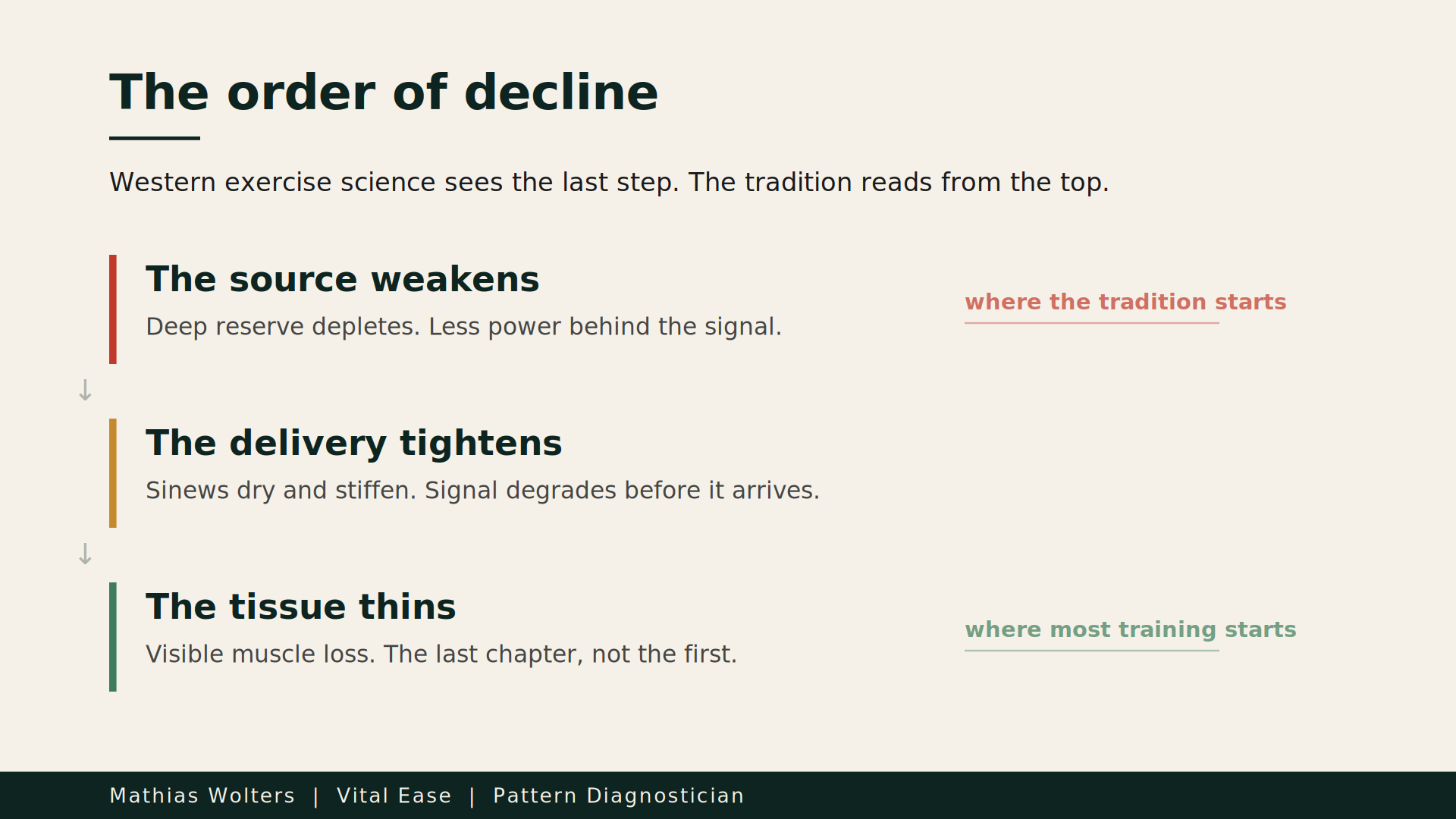
The signal fires from the deepest reserve you have, the one that depletes with age and does not come back easily. It is the root power, the thing underneath the hormones and the neural drive, and when it weakens, everything downstream receives less instruction. This is not the same as being tired. You can sleep well and eat well and still feel the output dropping, because the source of the signal is running lower than it was.
The delivery runs through what the tradition calls the sinews, the connective architecture between nerve and muscle. When this is well nourished, the instruction travels cleanly. When it is dry or tight, the signal degrades before it arrives. This is why someone with tight, braced, stiff tissue is often weaker than their muscle mass suggests. The wiring is compressed.
The receiving end is the tissue itself, and its ability to hold what it has. This is the part that eventually shows up as visible muscle loss, but it is the last in the chain, not the first.
So the order of decline is: the source weakens, the delivery tightens, the tissue thins. Western exercise science sees the last step and prescribes load. The tradition reads the chain from the top and starts where the signal originates.
That is not a philosophical difference. It produces a completely different training prescription.
What rebuilds the signal
Isometric holds. Not moving against resistance. Holding against it.
An isometric contraction, a muscle producing force without changing length, does something that a conventional lift does not. It demands maximum neural recruitment without the joint stress, the eccentric damage, or the cortisol cost of a full movement under heavy load. The signal has to fire at full intensity, but the system is not torn down in the process.
This is the oldest form of strength training in the tradition I practise. Standing still, holding a posture, letting the body organise force without movement. Zhan Zhuang is an isometric practice, and its purpose was never muscular endurance. It was signal training. Holding the structure while the unnecessary effort drops away, until what remains is clean recruitment and nothing else.
You do not need a tradition to do this. You need a wall.
Wall sit. Back flat against the wall, thighs parallel to the floor or as close as you can manage. Hold. Thirty seconds to start, building to two minutes over weeks. Breathe normally. Do not hold your breath.
Dead hang. Hang from a bar with straight arms. Grip as long as you can. This directly loads the grip, which is the metric we started with. Start with whatever you can hold and add five seconds per week.
Plank on forearms. Hold the position. Thirty seconds to a minute. No sagging, no forcing. The trunk has to produce force through the whole chain from feet to shoulders without movement.
Three holds. Three minutes total. No equipment beyond a bar and a wall. No cortisol spike, no recovery debt, no injury risk. Do them three times a week and measure one thing.
The metric
Buy a hand grip dynamometer. Around 25 dollars for a reliable one.
Test your grip once a week, same hand, same time of day, three squeezes, take the best. Write the number down.
That number is tracking the signal, not the muscle. If it is climbing, the neural drive to the tissue is improving. If it is flat or falling despite training, the training is not reaching the right layer.
Over three months of isometric work, most people see grip strength climb before any visible change in muscle. That is the signal rebuilding ahead of the tissue, which is the correct order. The tissue follows when the instruction improves. Not the other way around.
When the source is genuinely low
If the deep reserve has been depleted for years, by overwork, by age, by illness, by a decade of running in first gear, then isometric holds will improve the delivery and the recruitment, but they cannot refill the source.
This is the founder who does the holds, sees modest improvement, and then plateaus below where they should be. The signal is cleaner, but there is less power behind it. That is not a training problem. It is a reserve problem, and it needs to be read and addressed with herbs and a sequenced protocol that rebuilds the root without spending what is left of it.
That is clinical work. But the isometric practice is the foundation it sits on, and it is worth starting now regardless of where the reserve is, because a clean signal path makes everything that follows work better.
Before you close this
You are not losing muscle first. You are losing the signal that tells the muscle what to do, and that has been declining quietly for longer than you think.
Do not train harder. Train smarter, and for this stage of life, smarter means isometric. Load the signal. Spare the system. Measure the grip.
Wall sit, dead hang, plank. Three minutes, three times a week. Get the dynamometer and write the number down. In three months you will know more about where your body actually stands than any panel has told you.
The research calls grip strength a predictor. That is true, but it undersells the finding. It is not predicting your future. It is showing you, right now, how well the deepest part of your system is still reaching the surface. And that is something you can change.
Mathias
P.S. The grip measures whether the signal is reaching the surface. The Sovereign Biological Audit reads what is behind the signal: 40 markers across eight systems, including the hormonal and metabolic reserve that powers the neural drive. vitalease.co/the-sovereign-biological-audit