Stress Is The Symptom, Not The System
Stress is the symptom, not the system — and why your normal cortisol result is the beginning of the clinical story, not the end. The Normal Result That Wasn't. The cortisol came back normal.
Stress is the symptom, not the system — and why your normal cortisol result is the beginning of the clinical story, not the end. The Normal Result That Wasn't.
The cortisol came back normal.
So did the MRI. The neurologist ordered it after the third month of tension headaches that arrived every afternoon without exception — starting at the base of the skull, spreading forward, lasting until sleep. The scan showed nothing. No lesion. No structural explanation. The neurologist said what neurologists say when the instrument returns nothing: the brain looks fine.
The gastroenterologist said something similar. The endoscopy was unremarkable. No inflammation visible at the mucosal level.
No structural abnormality in the tissue. The founder had described three years of a gut that was quietly, persistently unreliable — bloating after meals that had no obvious trigger, alternating bowel habits that responded to nothing he adjusted, a ribcage tightness after lunch that he had learned to expect and could not explain. The scope found nothing. He was told it was probably stress.
The cardiologist ran the stress test after the founder mentioned the chest tightness. Normal. The cardiac output under exertion was appropriate for his age. The heart was structurally sound.
The GP ordered the cortisol. It came back within range. The HPA axis, the test confirmed, was functioning. Adrenal output was not elevated. The founder was, by every instrument that had been applied to him across eighteen months and four specialities, medically fine.
He did not feel fine. He felt like a system running under permanent load — tighter than it should be, slower to recover than it used to be, producing symptoms that each specialist had correctly identified as not belonging to their domain and passed along to the next. The headaches were not neurological. The gut was not gastroenterological. The chest was not cardiac. The cortisol was not endocrinological.
Each instrument reached its ceiling. Each specialist reported what their instrument could see. And what none of them could see — because no single instrument in the Western diagnostic sequence was designed to look for it — was the pattern running underneath all five presentations simultaneously.
Why the Tests Have a Ceiling
Because every instrument returned a normal result while the founder continued to feel the pattern in his body, the question becomes precise: not why Western medicine failed — but what Western medicine's diagnostic sequence is structurally designed to find, and what it is structurally unable to see.
The cortisol blood draw measures adrenal output at a single point in time. It captures a snapshot — the level of cortisol circulating in the blood at the moment the needle entered the vein. If that snapshot falls within the reference range, the HPA axis is declared functional. What the test cannot measure is the chronic systemic state that precedes the output — the pattern of autonomic bracing, the sustained sympathetic tone, the nervous system that has been running at elevated baseline for so long that it has recalibrated what it considers normal. The cortisol reading is within range. The system producing it is not.
The MRI looks for structural lesion. It maps tissue. It identifies damage that has already occurred at the level of physical anatomy — tumour, infarct, demyelination, haemorrhage. What it cannot see is functional restriction — the chronic amplification of normal sensory signals that occurs when the nervous system has been in sustained sympathetic bracing long enough to lower its pain threshold. Central sensitisation is not a lesion. It is a state. The brain amplifies minor muscular tension in the upper trapezius, the jaw, and the suboccipital muscles into pain that arrives with the reliability of a scheduled event — every afternoon, without structural cause, because the nervous system has been sensitised to produce it. The MRI returns normal. The mechanism producing the headache is not the mechanism the MRI was designed to detect.
The EEG measures electrical activity — the firing patterns of neurons in real time. It identifies seizure activity, abnormal wave patterns, the signatures of specific neurological conditions. It does not measure the autonomic nervous system's chronic suppression of vagal tone. It does not see the HRV signature of a nervous system stuck in sympathetic dominance. The electrical activity of the brain can be completely unremarkable while the autonomic architecture underneath it is structurally dysregulated.
The gastroscopy images the mucosal lining directly. It identifies ulceration, inflammation visible at the tissue level, structural abnormality in the gut wall. What it cannot see is the functional consequence of chronic vagal withdrawal — the suppressed bile motility, the altered gallbladder contractility, the smooth muscle tension throughout the gastrointestinal tract that produces bloating, ribcage tightness, and alternating bowel habits without leaving a mark on the mucosa. The scope finds nothing. The mechanism producing the symptoms operates above the level of tissue — in the autonomic regulation of the gut's smooth muscle architecture.
The cardiac stress test evaluates structural cardiac output under controlled exertion. It identifies ischaemia, arrhythmia, the functional ceiling of the heart under load. It does not measure chronic HRV suppression — the beat-to-beat inflexibility that reflects a heart that has lost its adaptive capacity to stress. A founder can pass a cardiac stress test comfortably while his overnight HRV reflects a nervous system that has not fully downregulated in three years.
This is not a failure of Western medicine. These are precise instruments answering the questions they were designed to answer. The cortisol test asked: is adrenal output currently elevated? The MRI asked: is there structural damage in the brain? The EEG asked: is there abnormal electrical activity? The gastroscopy asked: is there visible mucosal lesion? The stress test asked: can the heart perform under acute load?
Every answer was correct. Every instrument reached its ceiling before the question the founder's biology was actually asking had been named.
The question his biology was asking was not about output. It was about pattern. And pattern diagnosis requires a different instrument entirely.
One Pattern, Five Symptoms
Because the Western diagnostic sequence is designed to read outputs and structures rather than patterns, the founder leaves four specialists with four normal results and no explanation for why five symptoms that arrived together continue to persist together.
Chinese Medicine does not begin with the symptom. It begins with the pattern.
And the pattern the founder is presenting — tension headaches in the afternoon, ribcage tightness after meals, digestive unreliability, suppressed HRV, irritability that arrives without obvious trigger and does not resolve with rest — is not five separate problems requiring five separate investigations. It is one obstructed flow pattern expressing itself through five channels simultaneously.
The pattern is called Liver Qi Stagnation.
Not liver disease in the Western sense — no hepatic inflammation, no elevated transaminases, no structural pathology that a blood panel or ultrasound would identify. The Liver in Chinese Medicine is a functional system — the organ responsible for ensuring the smooth, unobstructed flow of Qi through the body's pathways. When that flow is chronically impeded — by sustained emotional pressure, by years of unresolved sympathetic activation, by the kind of low-grade, never-quite-resolved tension that characterises a founder's operating environment — the system begins to constrict. The flow slows. The channels narrow. And the obstruction expresses itself wherever the flow meets the most resistance.
In the head, chronic Qi obstruction produces the sustained muscular tension that central sensitisation amplifies into afternoon headaches. The mechanism is not structural — it is the nervous system, sensitised by months of autonomic bracing, converting minor tension into pain with the reliability of a scheduled event.
In the ribcage and digestive tract, Liver Qi obstruction directly suppresses vagal tone — the parasympathetic nerve activity that governs smooth muscle relaxation, bile secretion, and gallbladder motility. When vagal tone drops, bile flow alters. The smooth muscle lining of the gastrointestinal tract tightens. The ribcage feels compressed after meals. The bowel becomes unpredictable.
The gastroscope finds nothing because the problem is not in the tissue — it is in the autonomic regulation of the tissue.
In the cardiovascular system, the obstruction manifests as suppressed HRV — the loss of beat-to-beat flexibility that reflects a heart operating under chronic sympathetic load. The cardiac stress test passes because the structure is sound. The HRV reading fails because the autonomic architecture governing the structure has lost its adaptive range.
In the emotional register, Liver Qi obstruction produces the irritability that arrives without obvious cause and does not respond to rest — because it is not a psychological response to a specific stressor. It is the somatic expression of a system under sustained pressure that has no outlet. The Qi that cannot flow becomes the mood that cannot settle.
Five symptoms. One pattern. The same obstruction upstream of all of them.
Western medicine saw five presentations and consulted five specialties. Chinese Medicine sees one clinical picture and asks one question: where is the flow blocked, and what is blocking it?
The answer to that question changes everything about what is done next.
The Marker Cluster That Moves Together
Because Liver Qi Stagnation is a pattern rather than a single output, it cannot be confirmed by any single test. What it can be confirmed by is a cluster — a specific constellation of markers that, when read together rather than in isolation, tells the clinical story that no individual instrument can carry alone.
This is the diagnostic shift that changes what the founder's data actually means.
The first marker is HRV. Not a single reading but the trend — the chronic suppression of RMSSD and SDNN scores that reflects vagal withdrawal over time. In a regulated nervous system, HRV oscillates with the demands of the day — rising in recovery, falling under load, returning to baseline between sessions. In a founder with established Liver Qi Stagnation, the oscillation flattens. The nervous system loses its adaptive flexibility. The HRV does not recover between stressors because the stagnation maintains a continuous background of autonomic bracing that prevents the parasympathetic system from fully asserting itself. A single HRV
reading tells very little. Three months of suppressed overnight
HRV with no recovery trend tells the pattern precisely.
The second marker is the cortisol awakening response. Not the midday cortisol snapshot that the GP ordered — the morning curve, measured across four to six salivary samples in the first hour after waking. In a regulated HPA axis, cortisol spikes sharply within thirty minutes of waking — the cortisol awakening response, the biological signal that the system is prepared to engage with the day. In a founder with Liver Qi Stagnation, this curve is flattened. The morning spike is blunted or delayed. The system that should mobilise cleanly at dawn is already depleted by the chronic background bracing that stagnation maintains through the night. A normal midday cortisol reading does not see this. The awakening response does.
The third marker is the pulse. In Chinese Medicine, the Liver Qi Stagnation pulse has a specific quality — described as wiry, taut, like a pressed guitar string under the fingers. It is not a metaphor. It is a palpable clinical finding reflecting the sustained vascular tension that chronic sympathetic activation produces in the arterial walls. No Western instrument routinely measures this. A clinician trained in pulse diagnosis reads it in thirty seconds.
The fourth marker cluster is inflammatory. Sub-clinical elevations in interleukin-6 — not high enough to trigger a clinical flag, but persistently above the founder's own baseline — reflect the low-grade systemic inflammation that chronic sympathetic tone generates through its suppression of anti-inflammatory vagal pathways. Alongside this, skewed prostaglandin ratios reflect the altered vascular tone and smooth muscle regulation that Liver Qi obstruction produces throughout the body's connective tissue.
The fifth marker is digestive. Decreased fecal elastase — an enzyme produced by the pancreas that reflects the adequacy of digestive enzyme secretion — and delayed gastric emptying, measurable through breath testing, both reflect the vagal withdrawal that Liver Qi Stagnation produces in the gastrointestinal tract. These are not findings the gastroscopy was designed to detect. They require different questions, different tests, and a clinician who knows to order them because the pattern has already indicated where the obstruction is expressing itself.
No single one of these markers is diagnostic in isolation. Together they form a clinical picture that moves as one — because the obstruction producing all of them is one. When HRV is suppressed, the awakening response is flattened, the pulse is wiry, the inflammatory markers are sub-clinically elevated, and the digestive enzymes are reduced — the pattern is not ambiguous. The instruments are reading the same upstream obstruction from five different angles.
This is what pattern diagnosis makes visible that output measurement cannot. Not a new test. A different way of reading the tests that already exist — and knowing which additional questions to ask because the pattern has already indicated where to look.
Where It Goes If Nobody Reads It
Because Liver Qi Stagnation is a pattern rather than a disease, it occupies the clinical space that Western medicine has no language for — the territory between a normal result and a diagnosable condition. The founder is not sick. He is not well. He is in the gap between the two — and the gap has a direction.
Chinese Medicine has observed this direction with forensic precision for two thousand years. Stagnation does not remain stagnation indefinitely. It progresses. And the progression follows a logic that is as mechanical as any pathological cascade Western medicine has mapped — because it is the same cascade, named differently.
The first transformation is heat.
Stagnation creates friction. Friction generates heat. This is not metaphor — it is the physiological consequence of chronic sympathetic activation suppressing the anti-inflammatory pathways that vagal tone normally maintains. When the Liver Qi is obstructed long enough, the subclinical interleukin-6 elevations that appeared in the marker cluster begin to climb. The low-grade systemic inflammation that was a signal becomes a state. The vascular walls that were tense become inflamed. The founder who had tension headaches and ribcage tightness begins to develop hypertension. The cortisol that was within range begins to dysregulate the insulin receptor. The metabolic syndrome that was not yet present begins to organise itself around the chronic inflammatory terrain that stagnation prepared.
The second transformation is invasion.
In Chinese Medicine, the Liver system — when obstructed and overcharged with stagnant Qi — begins to assert itself into adjacent systems. The digestive system, governed by the Spleen and Stomach, is the most vulnerable. Wood overacting on Earth — the Liver overwhelming the digestive centre. Physiologically this is vagal withdrawal damaging the mucosal lining, compromising the tight junctions, and altering the microbiome architecture that immune regulation depends on. The founder who had bloating and alternating bowel habits develops IBS. The altered biliary flow that produced ribcage tightness after meals progresses to SIBO. The reflux that was occasional becomes GERD. The gut that was unreliable becomes structurally compromised.
The third transformation is stasis.
When Qi stops moving for long enough, the blood it pushes stops moving with it. This is the transformation Western medicine calls microvascular disease — localised hypoxia, tissue hypercoagulability, poor lymphatic drainage in the tissues where the obstruction has been most persistent. The founder who had suppressed HRV and sub-clinical inflammation develops hepatic steatosis — the liver accumulating fat because the metabolic clearance that healthy Qi flow supports has been compromised for years. The chronic migraines that replaced the tension headaches reflect the vascular component of blood stasis in the cerebral circulation. In women, the same progression produces uterine fibroids and endometriosis — the physical crystallisation of years of obstructed flow into structural tissue changes.
And at the furthest end of the cascade — the one that no specialist mentioned when the cortisol came back normal and the MRI showed nothing — prolonged tissue hypoxia from blood stasis creates the cellular environment in which pre-malignant mutations have the conditions to organise.
This is where a normal cortisol result goes if nobody reads the pattern behind it.
Not inevitably. Not in every founder. The cascade has intervention points at every stage — and the earlier the pattern is identified, the less of the cascade has to be reversed rather than prevented. But the progression is not hypothetical. It is the documented clinical trajectory of a pattern that Western medicine encounters at the disease end of the cascade and treats there — without knowing that the obstruction that organised the disease was present and readable years before any instrument flagged anything abnormal.
The founder was told he was fine.
He was told the truth about what the instruments found. He was not told what the instruments could not see.
Release Versus Sedation
Because the pattern progresses if nobody reads it, the founder who finally understands what has been building upstream of his normal results arrives at the most practically important distinction in the entire essay.
Not what to take. What to do versus what to suppress.
The achieving mind, confronted with a pattern that produces tension headaches, digestive unreliability, ribcage tightness, and suppressed HRV, reaches for the tools that make the symptoms quieter. Alcohol in the evening — because it drops the nervous system out of the bracing state that the day has produced.
Cannabis before sleep — because it sedates the loop of unresolved cognitive charge that prevents the descent. Sleeping pills — because the system that cannot downregulate on its own needs chemical assistance to approximate the rest it cannot reach biologically.
These are not irrational choices. They work. The symptoms become quieter. The evening becomes more tolerable. The founder sleeps — after a fashion.
But they do not move the stagnation. They suppress the perception of it.
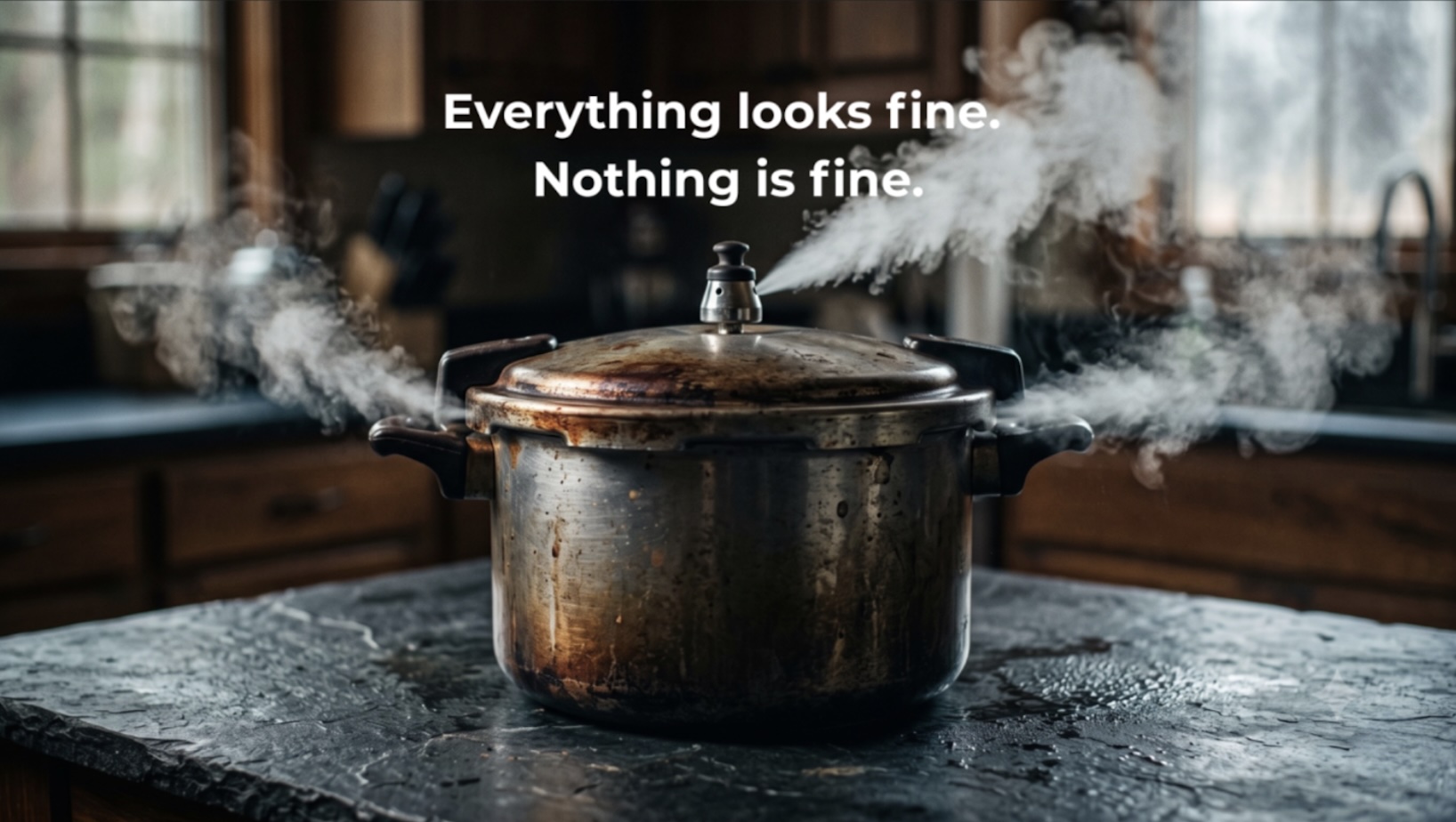
The distinction is precise and consequential. Alcohol, cannabis, and benzodiazepines sedate the brain's perception of the pressure the obstruction is generating — without touching the obstruction itself. The Qi is still blocked. The sympathetic tone is still elevated. The bile motility is still suppressed. The vagal withdrawal is still producing its cascade through the smooth muscle architecture of the gut. The pressure cooker is still sealed. The chemical intervention has simply turned down the gauge that was reporting the pressure.
When it wears off, the gauge reports again. Often louder than before — because the hepatic load of metabolising the sedating agent has added to the systemic burden the stagnation was already producing. The rebound is not weakness. It is the pressure cooker reporting accurately after the gauge was artificially suppressed.
What releases the stagnation is categorically different. It requires
physical or biochemical mobilisation of the obstruction itself — not suppression of its signal.
Acupuncture targeting specific points — Taichong LV-3 in particular, which directly drops sympathetic tone and activates vagal pathways — physically unbraces the smooth muscle restriction that stagnation has produced. The bile begins to move. The ribcage softens. The HRV begins to recover because the vagal tone that the obstruction was suppressing has been given a direct neurological pathway back to expression.
Somatic movement — shaking, sighing, the heavy exhale that drops the diaphragm fully — manually interrupts the chronic muscular bracing that stagnation maintains in the thoracic and abdominal structures. The diaphragm that has been operating at reduced range for years, held there by the sustained tension of sympathetic dominance, begins to complete its full excursion again. The vagus nerve, which runs alongside it, receives the mechanical stimulation that parasympathetic restoration requires.
Botanical formulas — Xiao Yao San in particular, the classical Chinese Medicine formula for Liver Qi Stagnation — move Qi through the Liver system while simultaneously supporting the Spleen's digestive function that chronic stagnation has been undermining. Not as a supplement to be optimised. As a precisely targeted clinical intervention matched to the specific pattern the marker cluster has identified.
That is not stress management. That is pattern medicine.
If you recognise the pattern described in this essay — the normal results, the persistent symptoms, the gap between what the instruments found and what your body has been telling you — the next clinical question is precise: where in the cascade does your pattern currently sit?
The Sovereign Biological Audit reads both layers simultaneously — the blood data that Western medicine measures and the CM pattern that gives those numbers their clinical meaning. Not two separate consultations. One forensic picture of the same biology, read from both sides.
vitalease.co/the-sovereign-biological-audit