Why you feel worse after work out
A founder in his late forties told me he had been training consistently for three years. Five sessions a week, mostly strength, some conditioning.
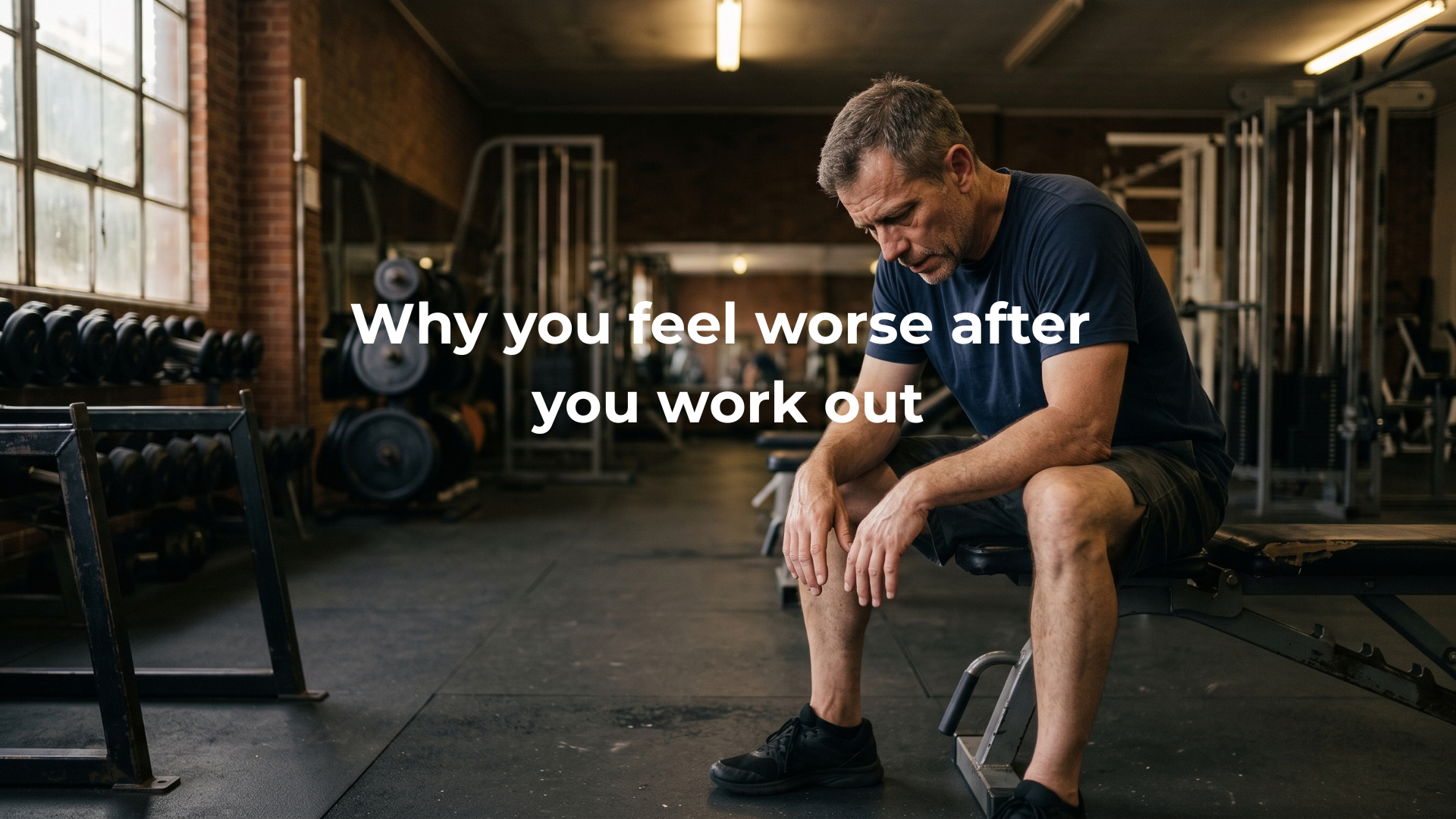
A founder in his late forties told me he had been training consistently for three years. Five sessions a week, mostly strength, some conditioning. He tracked everything. He ate well. He slept enough. On paper he was doing what every performance coach on his feed told him to do.
He was getting worse.
Not injured. Not overtrained in the textbook sense. Just slowly, quietly declining. The day after a session he was flat. Not sore, flat. Low energy, poor focus, a heaviness that used to clear by noon and now lasted into the evening. His sleep, which had been solid, started breaking at two or three in the morning. His recovery, which used to take a day, now took three. He was softer through the middle despite training more than he had in his thirties.
He assumed he was not trying hard enough. So he added a session. He went heavier. He signed up for a program with more volume.
He got worse faster.
What this gives you
A way to understand why training that used to build you is now tearing you down, and why the answer is not a better program. If you are past forty and you feel worse after you work out, this is not a discipline problem. It is a capacity problem, and capacity is fixable, but not with more load.
What training actually is
Training is not building. Training is damage.
You go to the gym, you break tissue down. Muscle fibres tear. Connective tissue takes micro-damage. The nervous system spends itself recruiting motor units under heavy load. Cortisol spikes to mobilise fuel. Inflammation rises locally to start the repair process. You leave the gym weaker than when you walked in.
The building happens after. While you sleep, while you eat, while you rest. Growth hormone pulses. Testosterone signals repair. The immune system clears the debris. The tissue rebuilds slightly thicker, slightly stronger, slightly more resilient than before.
That is adaptation. And it is the whole point of training. You are not paying for the session. You are paying for the rebuild.
When you are thirty and resourced, the rebuild outpaces the damage comfortably. You recover in a day. You come back stronger. The cycle works so well that you never think about it. You assume the training is doing the work. It is not. The recovery is doing the work. The training is just the request.

What changes after forty
The request stays the same. The capacity to answer it drops.
This is not dramatic. It is not a cliff. It is a slow, quiet shift in the ratio between what each session costs and what the rebuild can return. The cost stays constant because the weight on the bar has not changed. The return diminishes because the hormonal, nervous, and metabolic systems that power the rebuild are no longer operating at the level they were a decade ago.
Testosterone has been declining at roughly one percent per year since the early thirties. Growth hormone output has dropped. The deep reserve that powers the entire recovery cascade is lower than it was. Cortisol, meanwhile, has not declined. If anything, in a founder under sustained pressure, it has risen. So the damage signal is the same or louder, and the repair signal is quieter.
The gap between cost and return opens slowly. At first you just notice that recovery takes longer. Then you notice the soreness is different, deeper, less satisfying. Then the energy the day after starts to drop. Then the sleep breaks. Then the weight around the middle settles despite the work.
Each of those is the same thing. The rebuild is no longer matching the damage. And every session you add widens the gap, because each one costs recovery capacity that is already running short.
Why harder makes it worse
This is the part that nobody says because it contradicts the entire culture of training past forty.
A hard session spikes cortisol. In a young, resourced system, cortisol rises and falls sharply. It does its job and clears. In a depleted system, cortisol rises and does not come down as fast. It lingers. And while it lingers, it does three things that make the next session worse.
It suppresses the hormonal recovery response. Testosterone and growth hormone are blunted in a high-cortisol environment. So the damage happens on schedule and the repair is delayed.
It redirects fat storage into the visceral compartment. The founder training hard at six in the morning to lose the belly is spiking the hormone that deposits fat around the organs. The harder he trains, the more cortisol, the more visceral deposition. He is working against himself.
It disrupts deep sleep. Cortisol that has not cleared by evening keeps the system in alert mode and prevents the deep stages of sleep where the majority of tissue repair happens. He sleeps seven hours and wakes unrestored, because the quality of those hours has been hollowed out by the cortisol still circulating from the morning session.
More volume. More intensity. Earlier alarm. Longer sessions. Each one adds cortisol to a system that is already failing to clear the last dose. The founder who grinds harder because he is declining is accelerating the decline with every session.
What has to change
Not the program. The capacity to recover from the program.
Drop the volume first. Three sessions a week instead of five. Each one shorter. If you have been training for an hour, train for forty minutes. The stimulus you need to maintain and build at this stage is far less than you think, and every unnecessary set is a withdrawal from a recovery account that is already overdrawn.
Drop the intensity second. You do not need to lift at ninety percent to build. Moderate loads with controlled tempo produce the adaptation signal at a fraction of the cortisol cost. Isometric holds, slow eccentrics, controlled pauses. These recruit the muscle fully without the nervous system spike that heavy grinding produces.
Move the session later. The six a.m. session is the worst slot for a depleted system. Cortisol is already at its natural peak in the early morning. Training on top of that peak drives it higher than at any other time of day. Move it to late morning or early afternoon if you can. If you cannot, at minimum stop training fasted at dawn. Eat first.
Walk on the other days. Not as a substitute. As the recovery input the system actually needs. A thirty minute walk does not spike cortisol. It improves insulin sensitivity. It moves circulation without creating damage. It is the highest return, lowest cost movement available, and it is what your body is asking for on the days between sessions.
Eat after you train. Protein within an hour of the session. Not a shake if you can avoid it. Real food, warm, with protein and carbohydrates together. The rebuild starts with raw material arriving while the window is open. A founder who trains at six, skips breakfast, and eats at noon has left the rebuild unfunded for six hours.

When the program is right and it still does not hold
If you drop the volume, drop the intensity, eat after the session, walk on the off days, and the day-after flatness is still there after a month, the problem is not the programming anymore. The recovery system itself has declined to a point where even a well-designed stimulus exceeds what it can answer.
This is the honest limit of any training advice. You can optimise the request. You cannot optimise the capacity to answer it with a program. That capacity is biological. It lives in the hormonal reserve, the deep engine that powers the rebuild, and the conversion system that turns your food into the raw material for repair.
When that system has been running down for years, eaten by stress, irregular sleep, and the cortisol load of building a company, it needs to be rebuilt directly. Not with rest alone, although rest is the first step. With a precise read of where the reserve actually stands and what the recovery system can currently handle, followed by herbs and a sequenced protocol that rebuilds the engine from underneath.
That is the work I do. And it starts by answering the question the founder has been avoiding: is my body actually able to recover from what I am asking it to do right now. If the answer is no, then every session until the answer changes is a net loss, and the honest move is to train less until the floor comes back.
That is not weakness. That is the most intelligent training decision a founder past forty can make.
Before you close this
If you feel worse after you work out, you are not imagining it and you are not getting soft. Your body is telling you, accurately, that the cost of the session exceeded what the rebuild could return. That is a signal, not a failure.
Drop two sessions this week. Walk instead. Eat after you train. Sleep without the alarm. See what a week of lower cost does to your energy, your recovery, and your mornings.
The training that built you at thirty was never the training itself. It was the recovery underneath it. That recovery is what has to come back before anything else can work again.
You are not undertrained. You are under-recovered. And those are two completely different problems with two completely different fixes.
Mathias
P.S. The Sovereign Biological Audit reads 40 markers across eight biological systems against functional optimums rather than population averages. It shows where your recovery capacity actually stands and what has been pulling it down. That is the read that tells you whether your body can absorb what you are asking it to do. vitalease.co/sovereign-biological-audit